
From Interest to Construction Site: How to Really Succeed in 3D Building Printing
3D construction printing is generating considerable interest among many construction companies. At the same time, getting started with it raises very specific questions.
Is a planned building even suitable for 3D printing? How do planning and permitting change? What changes affect construction time, costs, and processes on the construction site? And how much personal experience is necessary to get started properly?
The process begins precisely at this point. Not in theoretical discussions, but in direct exchange with our experienced consultants. From the initial contact, they guide you through the entire process, answer your questions, and ensure that initial ideas become real construction projects – thus laying the foundation for a successful entry into 3D construction printing.

It's not just about technology, but about integration.
A common misconception is to view 3D building printing primarily as a purely technical innovation. In practice, however, success depends not on the technology alone, but on its integration into existing planning and construction processes.
Getting started with 3D printing is always a process of change. Roles shift, processes are adapted, and planning also needs to be adjusted. Therefore, there are several things to clarify beforehand. Successful projects show that early coordination of planning, materials, and dependencies is crucial. Only then does a new construction method become a structured and predictable process.
How the entry process actually works in practice
In most cases, the process begins with a specific construction project. Many construction companies approach us with a project they would like to implement using 3D printing. This allows us to immediately delve into the details together. Through our preliminary assessment service, we jointly examine the project's fundamental suitability.
We analyze the property and its parameters, the current planning status, floor plans and dimensions, as well as potential logistical challenges on the construction site. The planned construction sequence is also taken into account.
Based on this, we advise on whether adjustments are necessary. Above all, we clarify two key questions: Is it technically possible to 3D print the building? And is it economically and architecturally sound to do so? This realistic assessment forms the basis for all further steps.
Print-ready planning and approval
If the project is suitable, the planning for printing follows. Together with the planners involved, details are adjusted as needed and the necessary steps are integrated into the construction schedule. At the same time, we also support the permitting process with our experience.
Since our 3D printing solution is material-agnostic, we work together to select the appropriate 3D-printable material. This allows material costs and performance to be specifically tailored to the project requirements.
Select the appropriate system
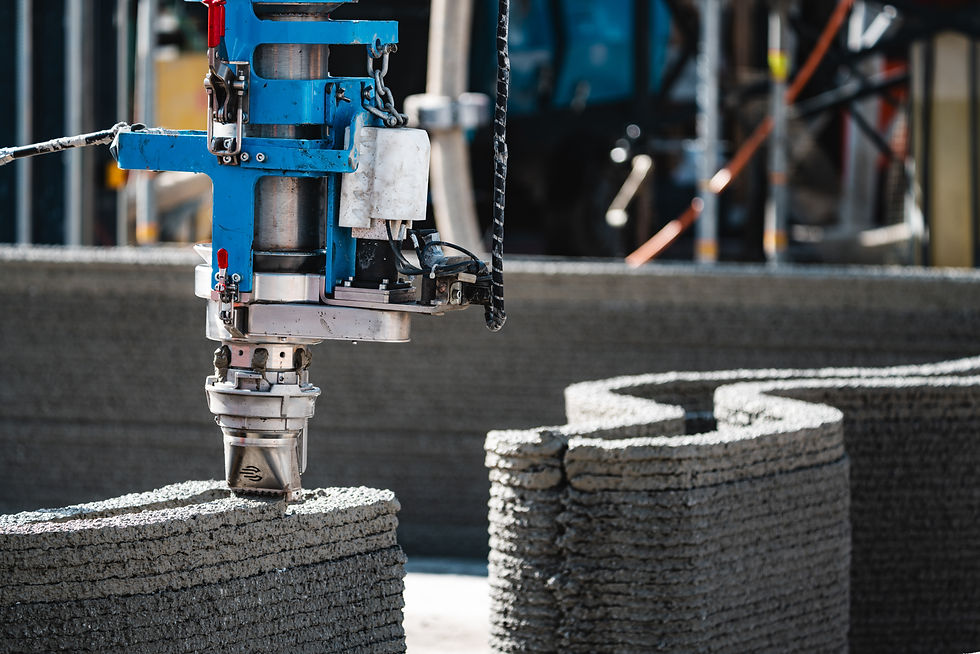
In parallel, the decision regarding the 3D printing system is made. Together, we define the appropriate configuration of the modular printer and assemble the suitable system for the silo and mixing pump. This results in a solution tailored to the specific project and offering all the prerequisites for a successful launch. We provide the complete system from a single source and supplement it with our sensor-based assistance system 3D MATCONTROL for easier operation.
Education and training
The next step involves preparing the team to work with the 3D printing system.
The training can take place at PERI headquarters in Weißenhorn or directly on the construction site. Within just a few weeks, we teach not only how to operate the system, but also a solid understanding of the processes, the fundamentals of quality assurance, and how to handle typical project situations. Prior experience in 3D printing is not required. An apprenticeship as a bricklayer or concrete worker is perfectly sufficient. Practical experience on construction sites is crucial.
Implementing the first project – together
The first project is typically implemented with the support of a PERI 3D Construction supervisor. This supervisor oversees the setup, printing process, and dismantling directly on-site. They ensure that the processes run smoothly, answer technical questions, and supplement the training content with practical experience. Afterward, companies are able to independently implement 3D printing projects. If needed, we provide collaborative support throughout the entire process, including for follow-up projects.
The first steps in 3D construction printing – a concise summary
Basic investigation:
Examination of the fundamental suitability of the project (floor plans, dimensions, logistics).
Print-ready planning & approval:
Integration of materials, interfaces and processes into the existing project structure.
Prepare and train the team:
Building team know-how through structured training – often directly on the construction site.
Implementing the first project with support:
Support during implementation to stabilize processes, clarify questions and ensure quality.
Use experience & think further:
Evaluation of initial experiences as a basis for further projects with PERI 3D Construction at your side.
The role of a strong partner
Adopting a new construction method requires experience in planning and implementation. As one of the most experienced partners in 3D building printing, we possess extensive project experience and, as part of the PERI Group, bring with us the familiar expertise and highest quality standards.
Our goal is clear: to enable our customers to work successfully with 3D printing from the very beginning. That's why we provide support from the initial consultation to the completion of the first 3D printing project, and gladly beyond. We offer expert knowledge, practical experience, and the right system solution to ensure that the advantages of 3D building printing become tangible.

Conclusion
3D construction printing is now a viable option for innovative construction companies. When entering the world of 3D printing, companies benefit from our experience, our sophisticated printing system, and our refined processes, which make the initial steps efficient and effective. This ensures that the transition to this new construction method is transparent, predictable, and therefore successful.


